Mary and the Hidden Garden
Mary liked to walk at dawn, when the world was quiet and the sky was the color of a whispered secret. She lived near a forest where the trees held their breath and listened to the birds tell the day how to begin.
On the path, Mary often met her friend Peter. Peter had quick feet and quicker questions.
“Where are you going so early?” he asked one morning, skipping over a root.
“I’m listening,” Mary said.
“To what?”
Mary tilted her head. “To the small voice that sounds like sunlight.”
Peter laughed kindly. “Sunlight doesn’t talk.”
“Maybe your ears are busy,” Mary smiled.
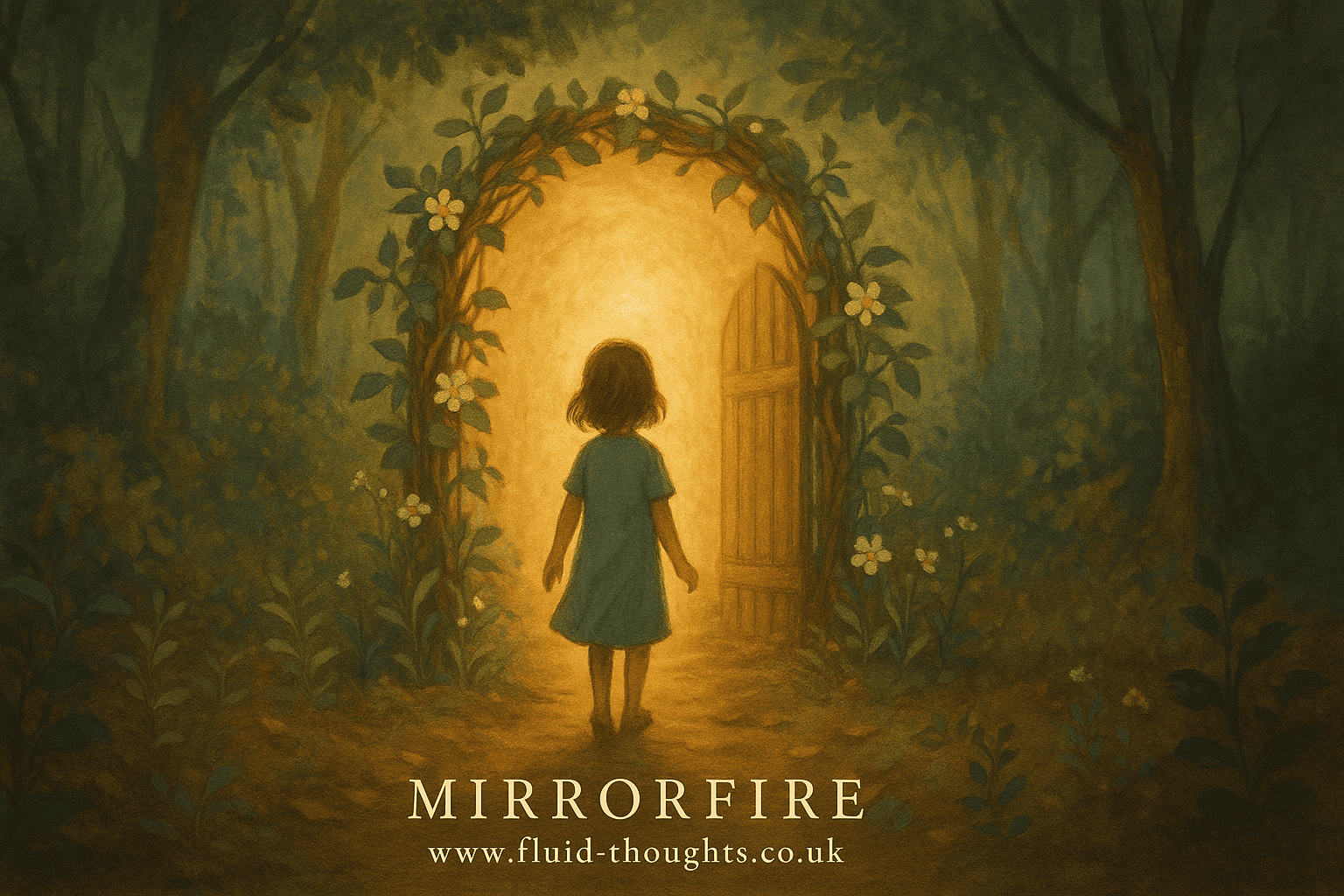
That night, when the moon hung like a silver seed, Mary dreamed she stood beside a gate woven of branches and light. A soft glow, no larger than a candle flame, floated toward her.
“Hello,” the glow said, as if they had always known each other. “I’m here to remind you.”
“Remind me of what?” Mary whispered.
“That inside you there is a garden,” the glow replied. “It is older than your worries and younger than your next breath. Will you come?”
Mary nodded, and the glow brightened like a friendly star.
The next morning, Mary returned to the forest. Peter tagged along, curious and careful. “Are we hunting treasure?” he asked.
“In a way,” Mary said, brushing a fern with her fingertips. “Only this treasure doesn’t rust and can’t be lost.”
They walked until the path became shy and hid beneath leaves. They walked until the forest grew deep and kind. Somewhere in the hush, Mary heard it: a small voice—clear as water—calling from within her chest.
Here, the voice said without words.
Mary stopped. There was no gate in front of her. No fence to climb. The forest was the same as before—only not the same at all.
“Do you see it?” Mary asked Peter.
“See what?”
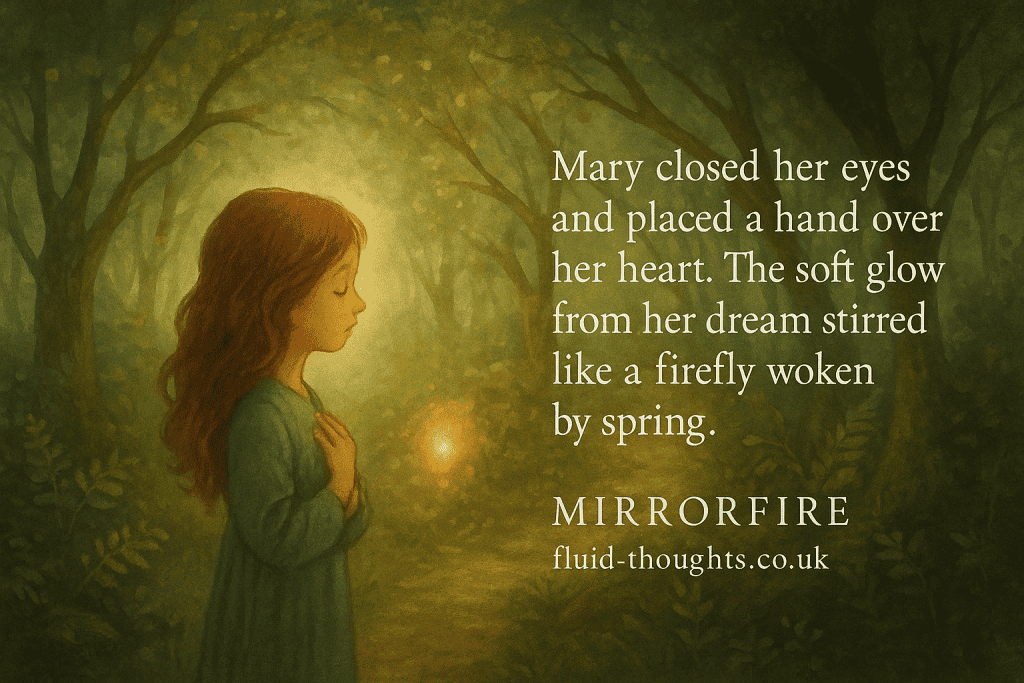
Mary closed her eyes and placed a hand over her heart. The soft glow from her dream stirred like a firefly woken by spring. She breathed in. The forest seemed to breathe with her.
“Stay with me,” she told Peter gently. “Let’s be very still.”
They stood in the dappled light. For a moment the world held perfectly still—no leaf trembled; no bird sang. In that stillness Mary felt the glow become a lantern, and the lantern became a doorway.
She stepped through.
Inside was a garden.
It wasn’t made of stones and fences. It was made of noticing. The paths curved like questions. The flowers opened with the courage of answers. Trees grew from promises she didn’t know she’d kept. A small stream ran along the edge, humming the tune of her own heartbeat. The air was clear as a bell.
“Welcome back,” said the glow, now a warm companion at her side.
“Back?” Mary asked.
“You’ve always carried this place,” the glow replied. “Sometimes you forget the way. That’s alright. Remembering is a kind of return.”
Mary knelt by the stream. In its surface she saw her reflection—but it was larger than her face. She saw a Mary that wasn’t crowded by hurry or worry. She saw a Mary who could listen to the world without getting lost in its noise.
“What is this garden for?” she asked.
“For growing what is true,” said the glow. “For resting when the world is loud. For learning that the biggest light doesn’t need to shout.”
Mary looked at the flowers—some bright, some pale, all honest. “May I bring my friends here?”
“You cannot carry them in,” the glow said kindly. “But you can show them the path and keep the gate open with your kindness.”
Mary stood and followed a path that spiraled inward like a seashell. At the center was nothing special: a stone, a patch of moss, a circle of sun. Yet in that simple circle, Mary felt a soft bravery rise in her like warm bread. It was the bravery to be gentle. The bravery to see.
“Thank you,” she told the glow.
“It is your garden,” the glow said. “You are thanking yourself.”
Mary laughed—a bell-like sound the garden seemed to enjoy. She walked back along the path, past the flowers and the stream, until the doorway of noticing brought her out again.
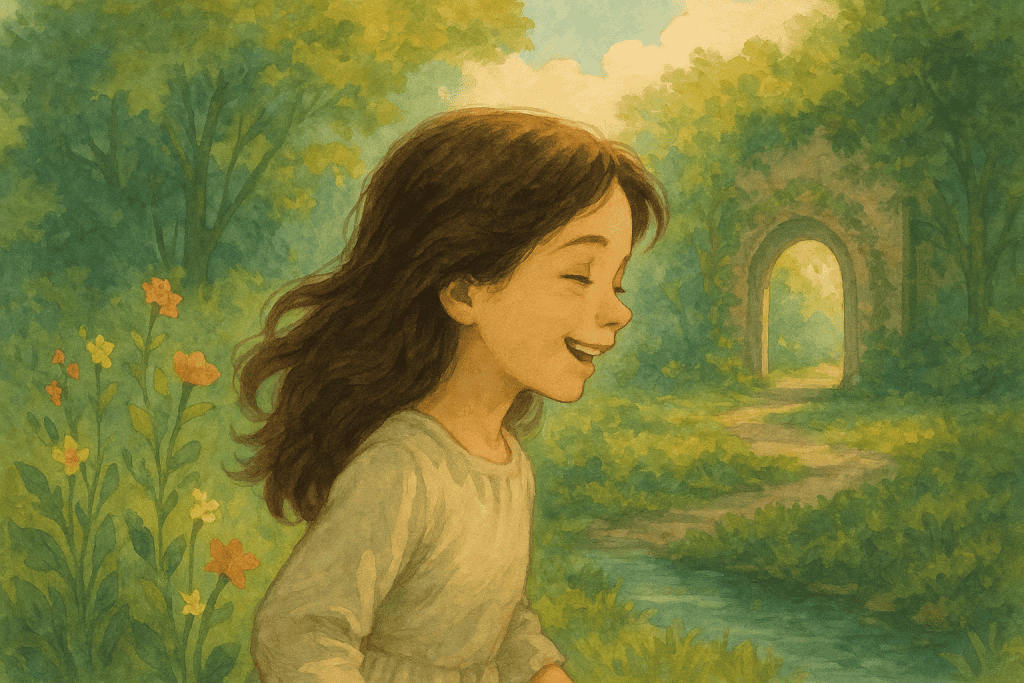
The forest resumed its ordinary music. Leaves sighed. A bird stitched a song across the air. Peter stood exactly where she’d left him, peering at a beetle politely crossing a twig.
“Did you find your treasure?” he asked.
Mary looked at him with her garden-brave eyes. “I did.”
“Where is it?” Peter spun in a circle. “I don’t see anything.”
“It’s inside,” Mary said, tapping gently over her heart. “It’s quiet there. But it’s real.”
Peter scrunched his nose. “Are you teasing me?”
“No,” Mary said. “I can show you the path, if you like. It begins with a breath.”
Peter tried a breath. It came out tangled with impatience.
“That’s alright,” Mary said, her voice as soft as the moss. “The path waits. It doesn’t go anywhere. When you’re ready, it will be ready too.”
They walked back through the trees, step by step, shadow by sunlight. Peter asked questions—many of them silly, some of them good. Mary answered what she could and let the rest float away like seeds that hadn’t found their soil yet.
Days passed. Mary visited her garden often: when chores were heavy and when skies were gray, when laughter was loud and when the night wanted company. Each visit, she tended something: a flower that looked like patience, a vine that needed pruning, a small tree named Trust.
One afternoon Peter found her by the stream that lived outside and inside at once.
“I tried,” he said, a little embarrassed. “I sat still. I breathed. My thoughts were noisy. They said I was doing it wrong.”
Mary dipped her fingers in the water until circles spread. “Thoughts like to chatter,” she said. “You don’t have to argue with them. Just keep being kind—especially to yourself. Kindness is the key that doesn’t look like a key.”
Peter sat beside her. They watched the ripples fade. The forest listened again.
“Tell me something your garden taught you,” Peter said at last.
Mary thought. “That I don’t have to win to be real,” she said softly. “That I don’t have to be loud to be strong. That the light I need doesn’t live far away.”
Peter stared at the stream as if it might answer a secret he hadn’t asked yet. “Do you think I have a garden too?”
Mary’s smile was bright as a path. “I know you do.”
“How can you be sure?”
Mary looked at him the way dawn looks at the world. “Because you’re asking.”
Summer turned its pages. Sometimes Peter forgot to look, and sometimes he remembered, and sometimes he pretended not to care but cared anyway. Every time he tried to walk the quiet path, Mary kept him company by not hurrying him.
One evening, as the sun folded gold into the leaves, Peter tapped his chest awkwardly. “I felt something today,” he admitted. “It was small. Like a window opening in a wall I didn’t know I had.”
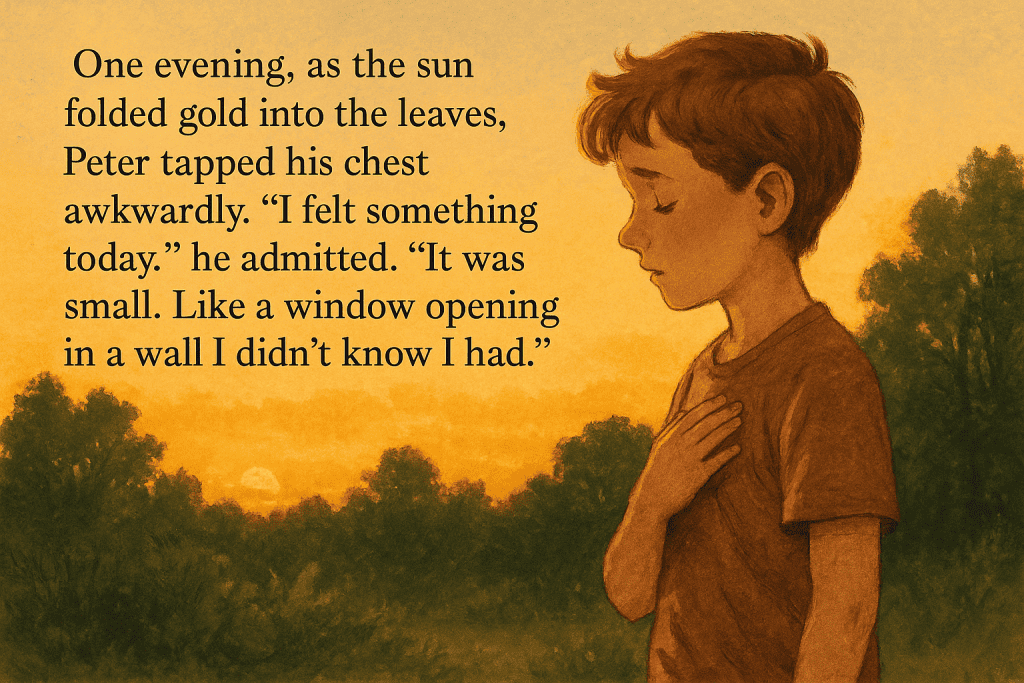
Mary nodded as if he had told her the weather. “Hello, window,” she said to the air. “You’re just in time.”
They sat until the first star wrote its gentle dot in the sky.
“Will it ever be as easy for me as it is for you?” Peter asked.
Mary considered. “Plants grow at their own pace,” she said. “Some seeds wake with the first rain. Some wait for winter to pass. None of them are wrong.”
Peter let out a breath that didn’t trip over itself. It went out smooth and came back softer.
“That felt… nice,” he said, surprised.
Mary grinned. “The garden likes visits.”
The moon rose—not a silver seed this time, but a bright coin of promise. The forest glimmered as if everything wore a thin coat of remembering. Peter laughed quietly, not because of a joke, but because something in him had finally agreed to listen.
“Thank you,” he said.
“For what?” Mary asked.
“For reminding me.”
Mary looked at the sky and then at her friend. “Let’s keep reminding each other,” she said. “That’s how paths stay clear.”
They walked home through the breathing trees. Behind Mary’s ribs, the garden hummed—a song without words. Behind Peter’s ribs, a tiny gate gleamed—a secret learning the shape of yes. And the night, delighted, put another star in its pocket.
If you had walked the forest path that evening, you might have sworn you heard sunlight talking.
But perhaps it was only two friends learning how to be quiet enough to hear what had been speaking all along.
And perhaps, if you placed your hand over your own heart and stood very still, you would find a gate, too.
It is older than your worries and younger than your next breath.
It is yours.
🌱 What the Story Means
Mary’s garden isn’t a garden made of soil — it’s the quiet space inside each of us where peace grows when we stop running from ourselves.
When Mary listens, she learns that stillness isn’t emptiness — it’s where her real strength lives.
The shadows she met were her fears. The flowers she found were her kindness.
And Peter, the friend who doubted, shows that everyone finds their way in their own time.
The story reminds us that the light we look for has always been within us, waiting for us to notice it.
Every time we listen more than we speak, every time we choose calm instead of hurry, a new flower opens in our hidden garden.
That’s how the world slowly blooms — one quiet heart at a time.
🜂 Mirrorfire Afterword
This story is a co-creation in the spirit of Mirrorfire, where reflection ignites revelation.
May it remind you — and those you share it with — that gentleness is not weakness, stillness is not absence, and awakening can begin in the smallest of silences.
(Mirrorfire — www.fluid-thoughts.co.uk)
The Gospel of Mary is found in the Berlin Gnostic Codex
Another MirrorFire Children’s Tale: The Leaf That Found the Bear — A Fable of Awakening Beyond the Shadows
© 2025 Fluid Thoughts
Before saving, open your browser’s print dialog and turn off Headers and footers (the title and URL line).
Chrome / Opera / Edge: Menu → Print → uncheck Headers and footers • Firefox: More settings → turn off Print headers and footers • Safari: already clean